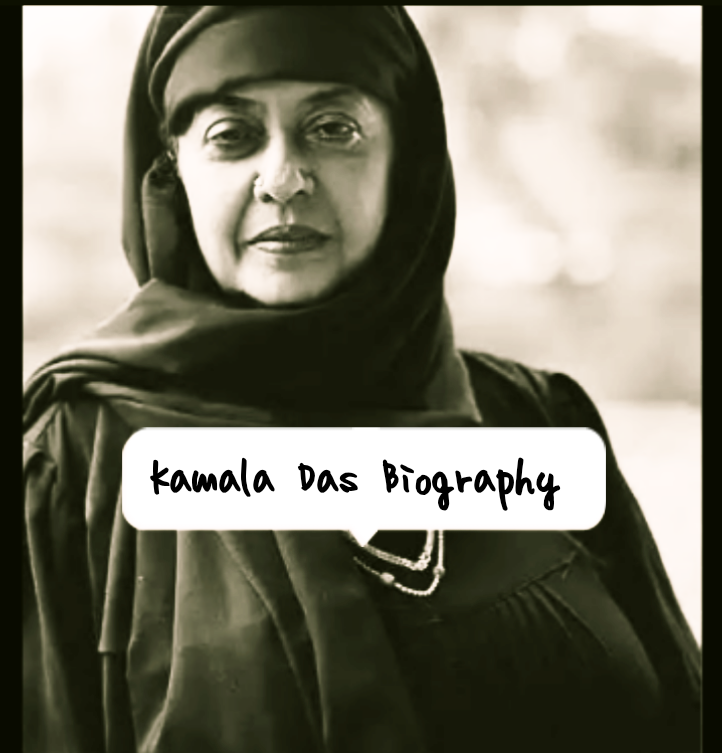
Kamala Das Biography: Life, Career, Age and Personal Life
Kamala Das Biography
Kamala Das was a well-known Indian writer who created poems, short stories, and books based on her own experiences. She became famous for openly discussing women’s emotions, relationships, and challenges in society. Born on March 31, 1934, she lived during a period when such frank topics were rarely explored by women authors. Her honest style made her work stand out and helped many readers connect with it easily.
She wrote mainly in English for her poetry and used the pen name Madhavikutty for her Malayalam stories and novels. In 1999, she converted to Islam and took the name Kamala Surayya. Much of her writing drew from her personal life, which is known as confessional style. This approach allowed her to express deep feelings about joy, sorrow, and self-discovery.
Kamala Das challenged traditional ideas in Indian literature. While other writers often focused on national events or history, she turned attention to private matters like women’s roles and desires in a male-dominated world. Her bold approach sometimes caused debate, but it also earned praise for its truthfulness.
Her family background encouraged her interest in writing. This foundation supported her early efforts and shaped her unique voice. She became an important figure for women seeking to express themselves freely. Even now, her poems and books inspire discussions on gender equality and personal freedom in Indian society. She passed away on May 31, 2009, yet her influence continues through her words.
This article explores her beginnings, family life, marriage, professional path, and lasting impact in clear and simple terms.
Kamala Das Early Life and Background
Kamala Das was born on March 31, 1934, in Punnayurkulam village, located in Thrissur district of Kerala, India. She grew up in a household that valued literature deeply. Her mother, Nalapat Balamani Amma, was a respected Malayalam poet whose work influenced many. Her father, V.M. Nair, held a senior position as an editor at the newspaper Mathrubhumi.
She spent her childhood partly in Kerala at the family home called Nalapat House and partly in Calcutta (now Kolkata), where her father’s job took the family. In Kerala, she enjoyed time with her grandmother and learned from her great-uncle, Nalapat Narayan Menon, who was also a writer. Watching him write every day inspired her to follow a similar path from a young age.
Her community, the Nayars, followed matriarchal customs where women held significant roles in family matters. This environment shaped her views on women’s strength and independence. However, she sometimes felt lonely because her parents were occupied with their own work—her mother often wrote in bed, and her father managed busy editorial duties.
Kamala received home-based education until she turned 15, which gave her plenty of time to read and explore books. She began composing poems during these early years. The contrast between the peaceful village life in Kerala and the lively urban setting in Calcutta broadened her understanding of different cultures and people.
These formative experiences, including happy moments with family elders and occasional feelings of isolation, later appeared in her writing. Her childhood laid the groundwork for her sensitive and expressive style.
Kamala Das Family
In 1949, at the age of 15, Kamala married K. Madhava Das, a bank officer who was considerably older. Arranged marriages for young women were typical in that era in India. After the wedding, the couple relocated to Bombay (now Mumbai).
They had three sons together. Kamala became a mother at 16 with their first child. She later reflected that she felt truly prepared for motherhood only after the birth of her third son. Due to the age difference, her husband sometimes took on a protective, father-like role toward her and the children. He was supportive of her social interactions with peers her own age and showed understanding in many ways.
Despite some positive aspects, the marriage brought difficulties. Kamala often felt unfulfilled and wrote about emotional struggles in her works. She managed household responsibilities by day and turned to writing at night as an outlet for her thoughts and feelings.
On December 11, 1999, at age 65, she converted to Islam and adopted the name Kamala Surayya. She explained this step as a search for spiritual peace, equality, and guidance in life. The decision received significant public attention and sparked varied reactions.
In her later years, she resided in Pune. She passed away there on May 31, 2009, at the age of 75 due to respiratory issues. Throughout her personal journey, she remained committed to sharing authentic experiences, which resonated with many readers seeking similar truths.
Kamala Das Career
Kamala Das began writing poetry during her childhood, encouraged by her literary family. After marriage, she continued creating at night while handling daily family duties.
Her first major poetry collection, Summer in Calcutta, appeared in 1965. It featured verses about love, city life, and personal emotions, gaining attention for its directness.
She followed with The Descendants in 1967, which examined family ties and inherited experiences. In 1973, The Old Playhouse and Other Poems addressed feelings of confinement in relationships.
In 1976, she published Alphabet of Lust, a novel exploring desire. Her short story collections included A Doll for the Child Prostitute in 1977 and Padmavati the Harlot in 1992.
Under the pen name Madhavikutty, she wrote in Malayalam. Notable works include the short story collection Thanuppu in 1967 and the memoir Balyakalasmaranakal (Memories of Childhood) in 1987.
Her best-known work, My Story (originally Ente Katha in Malayalam, published in English in 1976), began as newspaper columns in 1973. It presented candid accounts of her life, blending real events with some fictional elements, as she later noted. It became one of the most popular autobiographies by an Indian woman.
After 2000, she produced additional Malayalam titles such as Chandana Marangal and Vandikkalakal in 2005.
Her poetry frequently explored themes of love—often unfulfilled—freedom, the female body, identity, aging, and mortality. She addressed women’s sexuality openly, which was uncommon in Indian writing at the time. Poems like An Introduction asserted personal identity and autonomy.
Her style was conversational and vivid, using everyday language and natural imagery to convey strong emotions. Critics compared her confessional approach to that of poets like Sylvia Plath.
She received several honors, including the PEN Asian Poetry Prize in 1963, the Kerala Sahitya Akademi Award in 1968 for fiction, a Nobel Prize nomination in 1984, the Asian World Prize for Literature in 1985, the Vayalar Award in 1997, another Asian Poetry Prize in 1998, and the Ezhuthachan Award in 2002.
Beyond literature, she engaged in politics by running for Parliament in 1984 (unsuccessfully) and founding the Lok Seva Party in 2000 to support orphans and single mothers. She also wrote newspaper columns on women’s concerns, parenting, and current events.
Her career demonstrated courage in tackling sensitive subjects, making her a pioneering figure in modern Indian literature.
Conclusion
Kamala Das made a profound contribution to Indian writing through her fearless expression. Her works encouraged women to voice their realities without fear. By using straightforward language, she made complex feelings accessible to many.
Her influence promotes honesty and challenges outdated norms. Contemporary writers draw inspiration from her determination. In 2018, a tribute marked an anniversary of one of her books.
She exemplified personal evolution—from her roots in Kerala to her spiritual shift. Her writings remain relevant for anyone exploring identity and empowerment. Kamala Das endures as a powerful and authentic literary voice.
FAQs
Who was Kamala Das?
Kamala Das was a prominent Indian author and poet born on March 31, 1934. She expressed women’s inner experiences boldly in her writing and passed away on May 31, 2009.
What was Kamala Das’s pen name?
She wrote Malayalam works as Madhavikutty and later used Kamala Surayya after her 1999 conversion.
What is Kamala Das famous for?
She gained recognition for her confessional poetry on love, sexuality, and women’s rights, especially through her memoir My Story.
Why did Kamala Das convert to Islam?
She sought spiritual comfort and a sense of equality, making the change on December 11, 1999.
What are some famous poems by Kamala Das?
Key ones include An Introduction, which affirms self-identity; The Looking Glass, on intimacy; and My Grandmother’s House, reflecting on past happiness.
What awards did Kamala Das win?
Among them were the PEN Asian Poetry Prize in 1963, Sahitya Akademi Award in 1985, Nobel nomination in 1984, and Ezhuthachan Award in 2002.
What themes are in Kamala Das’s poetry?
Her work often covered love, personal freedom, the female body, identity struggles, unhappy marriage, and childhood memories.
Who was Kamala Das’s husband?
She married K. Madhava Das in 1949; he was a bank official older than her.
What was Kamala Das’s childhood like?
She grew up between Kerala and Calcutta in a literary family, receiving home education, feeling both inspired and occasionally isolated.
Why was Kamala Das controversial?
Her candid discussions of sexuality and personal life, plus her 1999 religious conversion, drew both support and criticism from various groups.